

X NÓW – Contemporary craft exhibition in the shop windows of Łódź service points
27.06–27.07.2025
X Nów in Lodz
The fifth edition of X NÓW—a contemporary craft exhibition in the shop windows of service venues—will take place in Łódź, a city primarily associated with the power of the textile industry. Factories, halls, weaving mills, and spinning mills shaped the local landscape, the rhythm of life, and the urban identity. Yet alongside these massive industrial establishments, there has always existed a quieter layer of Łódź: a network of small artisan workshops and studios—places where skill, precision, a connection with materials, and the daily work of human hands truly mattered.
Today’s new craft grows from these same values. Creators associated with the Nów. New Craft Association operate at the intersection of tradition and contemporary practice, balancing between handicraft, design, and art. They create unique forms in wood, ceramics, glass, metal, and textiles—sometimes functional, sometimes sculptural—always resulting from a careful dialogue with the material. Their work reflects respect for traditional techniques and locality, while also embracing contemporary forms of expression and experimentation.
The X NÓW exhibition places their works outside galleries—within the urban landscape of downtown Łódź, in shop windows and everyday public spaces. This initiative restores craft to its social place: close to people, close to the street, close to the city.
Curatorial walk: Friday, July 4, 2025, at 6:00 PM.
Second curatorial walk with a Polish Sign Language interpreter: Thursday, July 17, 2025, at 6:00 PM.
Start: Wasalaa, Roosevelta 10C (OFF Piotrkowska)
Makers:
Katarzyna Harasym, Huba, Aliona Kryshtofik, Olga Milczyńska, Kamila Mróz, P55 Mirrors, Beata Palikot-Borowska, Jakub Przyborowski, Square Drop, Beata Szczepaniak, Jakub Święcicki, Tartaruga Studio, Robert Wieczorek, Beata Wietrzyńska / In Weave, Magdalena Zarychta
Organizer: Stowarzyszenie Nów. Nowe Rzemiosło
Exhibition Partner: City of Łódź
Media partner: Design Alive
Curator: Jakub Przyborowski
Graphic design: Jakub Święcicki
Article at Design Alive LINK.
The project “X NÓW – Contemporary Craft Exhibition in the Shop Windows of Service Venues” is implemented thanks to funding from the City of Łódź budget.
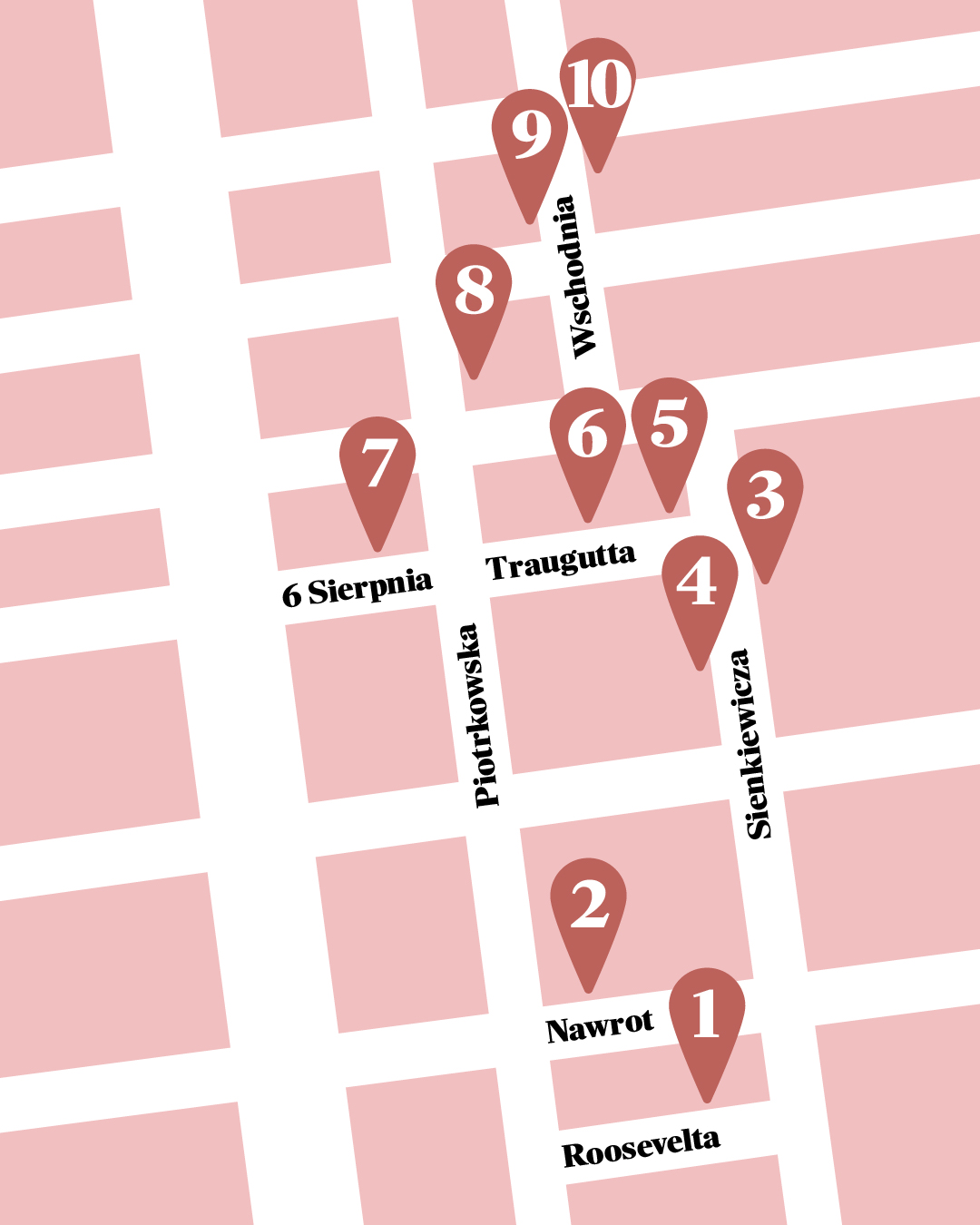
OBJECTS BY LOCATION ON THE MAP:
1. Wasalaa, ul. Roosevelta 10c
Beata Palikot-Borowska, Meadow From the Fashion for Little Stars collection, 2024
Technique and Material: Multi-ply/radziuszka weave on a cotton warp, wool weft.
The Meadow fabric is part of the Fashion for Little Stars collection. The collection is a work in progress—so far, ten fabrics have been created on a single warp, each unique in expression and purpose. The base of the fabrics in the Fashion for Little Stars collection is the “star” motif, a characteristic pattern of folk textiles from northeastern Poland woven using the radziuszka technique. The Meadow fabric is inspired by the meadows of Podlasie, offering a contemporary interpretation of nature. It is delicate, fleeting, and suggestive—a memory captured in the fabric, woven thread by thread into a light, airy textile, secured with a decorative band of hand-tied fringes.
Handwoven using the radziuszka technique. Traditional technique, contemporary form.
IG: instagram.com/beata_palikot_borowska
Katarzyna Harasym, Neocrystals, 2025
Technique and Material: Slumping, sandblasted crystal glass.
Neocrystals is an ongoing project, with forms that continuously take on different shapes. It is a series of crystal objects reflecting the passage of time and new life through transformation. The project began after the death of the artist’s grandmother in 2023. She inherited a damaged crystal vase and decided to fire it in a kiln, which led her to seek out old crystals to reshape them using the slumping technique. Matte and sandblasted, the Neocrystals appear like ghosts of previous crystal vessels, stretched through time. Each vase is unique and tells a different story.
IG: instagram.com/harasymkaska/
2. OMG – Oh My Glasses, ul. Nawrot 2A
Magdalena Zarychta, objects from the series Melting Joy: Green, Yellow, Lime, Lilac, 2025
Technique and Material: Blown, hand-shaped soda glass.
The “Melting Joy” series was born from a need for color—intense, vivid, and corporeal. For years, I worked mainly in transparent glass, often combined with metal. This contrast—hot and cold, soft and hard—carried both tension and fragility. Metal could be unpredictable; some pieces would crack, others would fall apart. At a certain point, I felt I no longer had to reconcile these contradictions—I could leave them behind and step into a space of freedom. “Melting Joy” is a series of unique glass sculptures—colorful, sensual, sometimes transparent, sometimes intensely colored, always one of a kind. It is my first time working with such a saturated palette—a gesture of courage, but also of necessity, as if body and imagination finally needed to be filled with joy. The forms into which I blow the glass I have been creating by hand for years. I sculpt, fire, and modify wooden molds, whose surfaces develop subtle distortions over time, making each work unique. In this series, I added steel inserts resembling steps or staircases, introducing contrast, structure, and tension. Working with fire, glass, and air is always a meeting with unpredictability—I let the material speak its own language, while also attempting to shape it according to my own intentions. Each sculpture is an experiment with color and texture, simultaneously glossy and matte, physically heavy yet visually ephemeral. They evoke sweetness without being sweet; they are bold, playful, and corporeal. They are an explosion of energy, a touch that electrifies and leaves a sensory memory. The series remains open-ended. Each new form is another expression of the same need—for contact with joy, color, and form. This is glass that does not submit, but instead plays—with light, shape, and me.
IG: instagram.com/magdalenazarychta.artist/
3. Roślinnik, ul. Sienkiewicza 20
Olga Milczyńska, objects from the series Posts Stands and Obstacles, 2024
Technique and Material: Coil-built, glazed stoneware.
The series was created with the idea of wandering and searching for the right path. The works in this series directly reference objects found along the road, accompanying us on our journeys, marking direction, or even **“substituting” the path for
IG: instagram.com/olga.milczynska/
Jakub Święcicki, Clayfrom the serie Monostriped landscape, 2025
Technique and Material: Naturally dyed with clay, faux chenille quilt, linen-viscose fabric.
The minimalist Clay object from the Monostriped Landscape series is inspired by the landscapes of the Świętokrzyskie fields and local raw materials. Using the faux chenille quilt technique and fabrics naturally dyed with local clay, repurposed from second-hand textiles, the artist created a decorative textile bas-relief with a richly textured surface. The natural pigments give the fibers a unique character that evolves over time. The dyeing process, which requires relatively low energy and water consumption, along with the use of recycled materials, significantly reduces the carbon footprint of the resulting object.
IG: instagram.com/_kuba_swiecicki/
4. Golden Beard Barbershop, ul. Sienkiewicza 23
P55 Mirrors, INBETWEEN No. 5 serie serii INBETWEEN, 2025
Technique and Material: Silvering, gilding on glass, laminated, painted and waxed wood, Optiwhite glass, green Antisol glass, silvering solution, white gold leaf, oak wood.
Double-sided, freestanding mirror It is an extension of the INBETWEEN series and stems from the need to expand mirrors with a kind of “frame.” The main concept of the composition is the juxtaposition of mirrored planes with semi- or fully three-dimensional objects. INBETWEEN No. 5, in which the mirrored panels correspond with wooden elements—planes. The larger green mirror was created using the silvering technique with corrosion, while the smaller one was made using white gold leaf.
Robert Wieczorek, Field, 2015
Technique and Material: Rips and rips derivatives, plain weave, Kowarska wool, sisal, linen.
The fabric, inspired by the fallow landscapes of the Kłodzko Valley, is a poetic interpretation of nature that has been abandoned, yet remains alive beneath the surface of time. Its structure reflects the uneven, deserted fields—former sites of human labor, now overgrown with dry grasses and shrouded in quiet snow. The layers of material are arranged like horizontal bands of fields—buried, yet not forgotten. In the central part of the composition, a white field appears symbolically, referencing the majestic Śnieżnik, the highest peak of the Kłodzko Valley. It is intersected by vertical accents reminiscent of bare trees, which—like the entire fabric—await the arrival of spring and renewal. This is a story of transience, memory, and the potential that lies dormant in what is abandoned. The structure of the textile captures a landscape—not only physical, but also emotional—full of longing, silence, and hope.
IG: instagram.com/robertwieczorekart
5. Małgorzata Olejniczak Hair Salon, 14 Traugutta Street
Square Drop, Little cabinet from the collection Odditydesigned by Kosmos Project, 2021
Technique and material: a piece of furniture made of solid, bleached ash wood, with brass elements
Little cabinet is part of the ODDITY furniture collection, which is the result of a collaboration by the brand Square Drop ze studiem Kosmos ProjectIt is an example of the combination of the multi-generational craftsmanship of a historic furniture workshop with contemporary design.
It exemplifies the fusion of multi-generational craftsmanship from a historic furniture workshop with contemporary design.
The construction of the furniture and the way it is finished highlight the sculptural character of the forms. The collection was created using exclusively Polish materials and in collaboration with local artisans. The furniture is made of solid ash, upholstered with wool from Tomaszów, the stone comes from deposits in the Świętokrzyskie Mountains, and the cast iron and brass fittings are crafted by local foundries and metalworkers.
Little Cabinet presented at the exhibition is an oval reference to the so-called 'table cabinets'—small cabinets with tiny drawers and compartments for storing small items, jewelry, or documents. Its decorative interior, hidden behind simple doors, adds an element of surprise. The piece can be displayed either closed or open. The door handle is left untreated, exactly as it was removed from the traditional casting mold. Solutions of this kind are intended to emphasize the craftsmanship involved in creating each element. The effect produced by the process itself becomes a form of decoration.
The natural materials and variety of textures give the furniture a highly sensual quality, with light refracting across its surfaces and altering perception depending on the illumination. All materials develop character over time, allowing the furniture to age beautifully and gain a sense of nobility. Each piece is signed.
6. Owoce i Warzywa, ul. Traugutta 9
tartaruga studio, Svolvær, 2025
Technique and material: kilim, warp: cotton, weft: recycled wool.
The Svolvær kilim is a record of memories from a journey through the Norwegian fjords—a convergence of many colors, scents, and fleeting emotions. It is a creative, nostalgic ode to polar days spent among fjords and mountains that descend all the way to the sea; a memory of the smell of salt and cod, of days spent climbing and observing nature, and the ever-present aroma of coffee and cinnamon buns. The cold, which penetrated to the bone, and the wind left a salty taste on the lips.
The Svolvær kilim is a frame that never existed, recorded in memory and transferred onto paper, and then woven thread by thread into the form of a kilim.
The kilim itself is a long-lasting and timeless textile, which makes Svolvær a kind of postcard—a personal memento from the journey.
The fabric was handwoven using the kilim technique on countermarch looms. Despite employing traditional techniques and tools, the pattern breaks the classical canon of kilim design. Recycled wool yarn, sourced from post-production carpet waste, was used to create the fabric. While it cannot be reused in industrial production, its excellent properties make it an ideal material for handcrafted work.
The kilim took two weeks to make.
IG: instagram.com/tartaruga.studio/
7. Ato Sushi, ul. 6 Sierpnia 1/3
Huba, Sculpture No.169/24, 2024 i Vase No.167/24, 2024
Technique and material: black ceramics, wood-fired kiln, unglazed terracotta.
The presented vase and sculpture are examples of the use of two different forming techniques.
The vase was thrown on a traditional kick wheel. The sculpture, on the other hand, represents an original technique—it was made from a single block of clay by cutting and tearing away pieces with a knife, and then hollowed out to prevent cracking during firing.
Both objects were fired in a traditional wood-fired kiln using a technique called reduction, which gives the clay its characteristic black color. After firing, the surfaces were hot-impregnated with beeswax and a special oil, ensuring water resistance and deepening the color.
Firing black ceramics is one of the oldest pottery techniques—once used in various regions of Poland, as well as in Lithuania, Ukraine, and Hungary. Today, it is rarely encountered, mostly in the context of historical and ethnographic reconstructions.
The presented forms have no counterparts in traditional black ceramics—they represent a step toward a new aesthetic within this disappearing craft, while also attempting to preserve it through development and reinterpretation.
IG: instagram.com/huba.studio.ceramics/
Kamila Mróz, Materia Prima – Venus, 2024
Technique and material: hand-blown glass, copper overlay, etching; glass, copper.
"The 'Materia Prima' series opens a new chapter in my creative work with glass, exploring the possibilities of hand-blown glass combined with molten metals.
As an artist, I work on many levels, like an alchemist, engaging both in physical manipulation of materials and in guiding subtle forces. I believe that progress requires the simultaneous development of inner awareness and external craftsmanship. The entire process is symbolized by the Aludel—an alchemical vessel representing the final stages of transformation and the act of creation itself. The name of this series is derived from Venus, the alchemical symbol for copper, which I use in this project."
IG: instagram.com/kamila_mroz_glass
8. Kraftowa, ul. Piotrkowska 48
Beata Wietrzyńska / In Weave, fabrics Wild Grapevine I and Wild Grapevine IV from the Traces collection., 2025
Technique and material: countermarch fabric using the distorted weft/additional weft technique; linen, sheep wool.
The fabrics from the Traces collection have a raw, minimalist form, serving as contemplative screens. They are made from materials rooted in tradition—natural linen and sheep wool. Traces are memories—fragments of images we carry within us. They are fleeting, blurred, hazy, and change over time. They transport us to places where we feel at ease, providing relaxation and comfort.
The fabric screens were woven on traditional wooden countermarch looms. The weave used is an original approach to the distorted weft—additional weft—technique. This method allows manipulation of color and pattern, creating the design directly on the loom (i.e., the background and pattern are woven together on the loom, although it appears as if the pattern were embroidered onto the finished fabric). In the works from the Wild Grapewine series, a shimmering rhythm of the additional weft—sheep wool in muted autumnal colors—appears on a neutral linen background. Working in a less-waste spirit, I use leftover yarn from previous projects, making the colors unique and each fabric a one-of-a-kind piece. The screens are framed, ready to hang, and signed on the back.The fabric screens were woven on traditional wooden countermarch looms. The weave used is an original approach to the distorted weft—additional weft—technique. This method allows manipulation of color and pattern, creating the design directly on the loom (i.e., the background and pattern are woven together on the loom, although it appears as if the pattern were embroidered onto the finished fabric). In the works from the Wild Grapewine series, a shimmering rhythm of the additional weft—sheep wool in muted autumnal colors—appears on a neutral linen background. Working in a less-waste spirit, I use leftover yarn from previous projects, making the colors unique and each fabric a one-of-a-kind piece. The screens are framed, ready to hang, and signed on the back.
9. tartaruga studio, ul. Wschodnia 54
Jakub Przyborowski, stool Untitled, 2025
Technique and material: dibetou wood (African walnut).
First came the table. I designed and built it at the end of last year, adapting it to the conditions of its final location—a dining corner in the clients’ kitchen. The rounded corners were intended to ensure comfortable and safe movement around the table. The softened edges eased the impact of accidental kicks from bare feet. The wood was chosen to catch the light beautifully from the nearby window and to harmonize in color with the finished seating, which included elements veneered with teak—dibetou was the choice.
When I was asked to make a stool to match the table, I decided to make two pieces. Often, when working on a piece of furniture, the preparatory tasks—making templates, measuring elements, or setting up tools—take more time than the actual work. In such cases, it seems a shame not to make an additional piece.
IG: instagram.com/jakub_przyborowski/
Beata Szczepaniak, Affection IX, 2024
Technique and material: hand-building using the coil technique, ceramics.
Affection IX is one of the works from the sculpture series. Affection / Przywiązaniewhich explores the theme of human relationships. The sculpture consists of three elements that exist in both physical and emotional tension with one another. The soft, biomorphic form is an abstract yet intensely bodily presence. The main, dark mass with a undulating, organic silhouette, in slight motion, rests on a base that seems to conform to its shape and weight. Toward the top, it branches out to form an openwork structure, gently lifting the smaller, lighter element—as if in a gesture of subtle contact, affection, or perhaps the smaller element is trying to break free from oppression, to separate. We do not know; interpretation is left to the viewer. The form evokes associations with intimacy and care, but also with tension and uncertainty.
IG: instagram.com/beata_szczepaniak_sculpture/
10. Karolina Lasota Ceramika, ul. Wschodnia 52
Aliona Kryshtofik, Geometric Composition #1-1 serie „Geometria”, 2024
Technique and material: ceramic casting, hand-building, porcelain, mixture of pigments and underglaze paints, custom glaze.
The ‘Geometry’ series is a continuation of the geometric sculptures, extended with additional elements in other materials. These are pedestals, manifesting color and composition.
The series was created as a technological challenge and an exploration of a different approach to the casting process. When creating porcelain casts, there is little time for any changes or manipulations of the shape. The desire to extend this process, combined with the need for creative interpretation, led to the creation of simple geometric elements that are joined together after casting. The entire process is a playful one, building objects that resemble block castles—colorful, simple, and sometimes appearing as if they might lose their balance. The series is inspired by childhood memories of porcelain in the cupboard.
Don’t miss the latest news, new products, and event updates. Subscribe to the Nów. New Craft newsletter:
Ta strona używa plików cookies. Kontynuując przeglądanie strony, akceptujesz treść Polityki prywatności.